
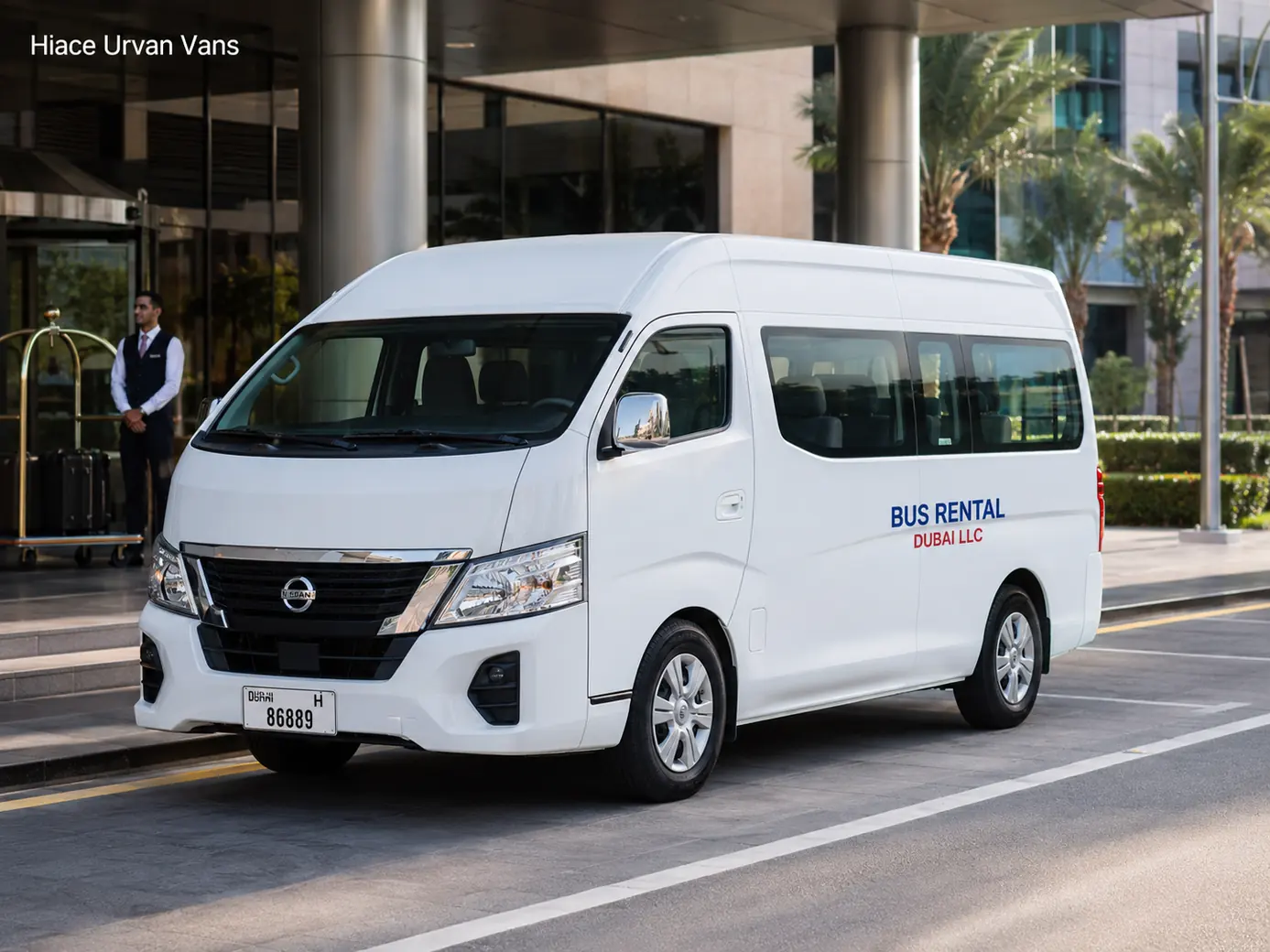
Van advantage
Fast boarding and easier access for hotels, towers and smaller private groups.
Choose the category that fits the route as well as the passengers. Vans favour compact access, minibuses balance capacity and manoeuvrability, while full buses protect group control when suitable staging is available.
For buyers deciding between compact, medium and large group transport, the vehicle-category comparison centres on whether compact access, mid-size flexibility or full-group capacity is the leading requirement. For the vehicle-category comparison, the operating answer should come from the complete movement rather than a preferred vehicle name or a rough rate request.

Compare vans, minibuses and full-size buses in Dubai by group size, luggage, access, route purpose and comfort before booking.
Fast boarding and easier access for hotels, towers and smaller private groups.
A practical middle ground for training groups, school trips and medium passenger counts.
Keeps large groups together and reduces the number of drivers and meeting points.
Each category still needs the same checks for luggage, duty hours, waiting and return.
This vehicle-category comparison is intended for buyers deciding between compact, medium and large group transport. The vehicle-category comparison separates confirmed operating facts from preferences that can remain flexible until availability is checked.

This vehicle-category comparison is intended for buyers deciding between compact, medium and large group transport. The vehicle-category comparison separates confirmed operating facts from preferences that can remain flexible until availability is checked.
A useful vehicle-category comparison should be concise enough for dispatch and complete enough for approval. The vehicle-category comparison must identify the constraint most likely to change the vehicle, route or price.
When the vehicle-category comparison contains several movements, list them chronologically. Within the vehicle-category comparison, transfer, waiting, return, shuttle and recurring work are different commitments even when the passenger group is unchanged.
A headline request behind the vehicle-category comparison can hide several duties. The examples below show how the vehicle-category comparison develops into separate operating plans.
A luxury or high-roof van may protect timing and access better than a coach that cannot wait at the lobby.
A minibus can keep the team together without the staging demands of a full-size vehicle.
A coach may provide better group control when the hotel and venue both have suitable boarding space.
A coach for the main movement and a separate premium van can solve presentation and access needs without splitting everyone randomly.
The vehicle-category comparison becomes clearer when alternatives are tested on one written basis. Keep these vehicle-category comparison factors visible during approval.
| Option or factor | Best use or question | Planning implication |
|---|---|---|
| Van | Small groups, airport transfers, towers and narrow entrances | Limited practical space when passengers carry several large bags |
| Minibus | Medium groups, school trips, staff teams and short tours | Capacity can be affected by supervisors, equipment and luggage |
| Full bus | Events, tours, staff movements and large coordinated groups | Needs more turning, staging and passenger-control space |
| Mixed fleet | Large group plus VIPs, supervisors or tight-access points | Requires one coordinator and a clear division of passengers |
Most avoidable problems in the vehicle-category comparison appear before dispatch. In the vehicle-category comparison, these errors can cause a wrong allocation, a revised price or a travel-day delay.
Advice for the vehicle-category comparison becomes reliable when the transport team can see the people, items, access and complete journey. For this vehicle-category comparison, confirm the following items before vehicle selection.
The case below connects the vehicle-category comparison with passenger needs, access, timing and commercial scope.
A group of eighteen international guests travels from DXB to a Marina hotel, joins a city tour the next day and carries one large case each. A van may suit the headcount poorly once luggage is loaded; a minibus can provide a cleaner single-vehicle movement without the access burden of a full coach.
Why it works: For the vehicle-category comparison, this example states the passenger movement, the main constraint and the service format before asking for a final vehicle or price.
These next steps turn the vehicle-category comparison into an approved transport requirement.
The questions below focus on decisions and objections that commonly arise during the vehicle-category comparison.
A van is often better for small groups, hotel entrances, business towers and routes where quick boarding and compact access matter more than large capacity.
Choose a minibus when the group is too large for a van or when luggage, supervisors, equipment or longer travel time need more space.
A full-size bus is better for large groups that must stay together and where the pickup point can handle coach staging and boarding.
Only if passenger count, luggage, comfort and access still work. A cheaper vehicle can create boarding or luggage problems if the group is too tight.
Yes. Tower entrances, hotels, schools, terminals and venue bays can make one category easier to operate than another.
Look at route length, passenger type, luggage and expectations. A short transfer and an intercity trip need different comfort planning.
Yes. Large groups may use a coach for the main movement and smaller vehicles for VIPs, supervisors or tight-access points.
Send passengers, bags, pickup entrance, destination, timing, waiting, return and service purpose.
Describe the people, bags, entrances and journey before naming the vehicle. The recommendation can then compare a van, minibus or bus on the same practical basis.